Longlist vs Shortlist in Innovation Scouting: How to Narrow Company Profiles with Confidence
Use practical stage gates, transparent inclusion rules, and stakeholder review to turn a broad longlist into a sponsor-ready shortlist.
Coopsaas Editorial Team
Coopsaas
Longlist vs Shortlist in Innovation Scouting: How to Narrow Company Profiles with Confidence
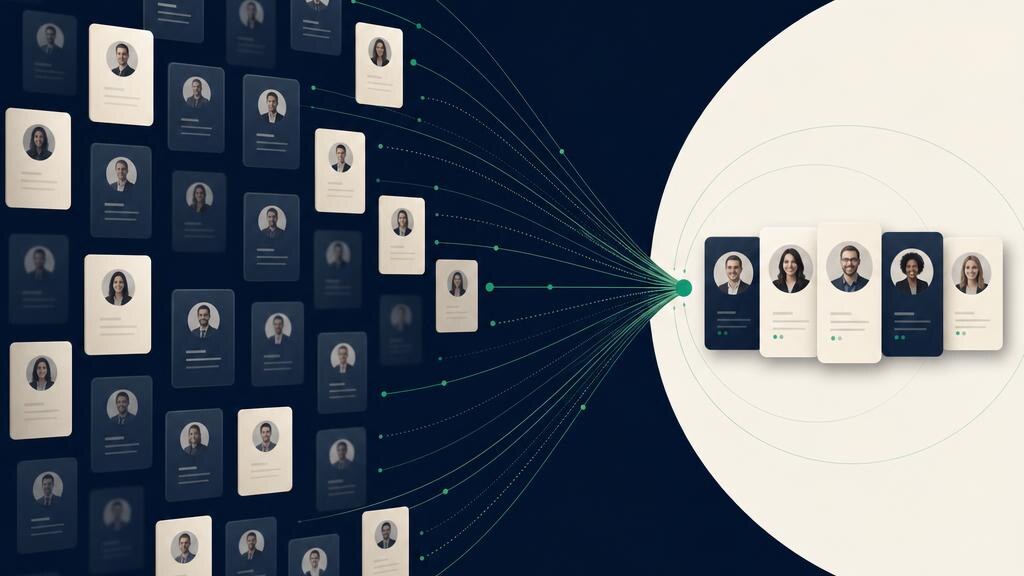
A longlist is the broad, traceable set of companies that may fit a defined innovation challenge; a shortlist is the smaller set that has passed deeper, consistent evaluation and is ready for a decision or conversation. Move between them using agreed criteria, recorded evidence, and stakeholder review, not enthusiasm alone.
What is the practical difference between a longlist and a shortlist?
The distinction is about the decision each list supports, not an arbitrary company count. A longlist supports coverage: it shows which plausible companies the team considered across the relevant search fields. It should be broad enough to reduce the chance that one familiar supplier, geography, or search term defines the answer.
A shortlist supports action. Each company on it should have enough evidence for a sponsor to understand the strategic fit, the material uncertainty, and the next sensible step. That may be an introduction, a technical session, a security review, or a pilot discussion.
Neither list is inherently better. A longlist that is too thin can conceal a weak search. A shortlist that is too large asks decision-makers to do the scouting again. The appropriate size depends on the challenge, the maturity of the market, team capacity, and the decision at hand. Set the list size only after agreeing what the next gate requires. For the wider sequence, from challenge framing through evaluation and partner selection, see Coopsaas’s startup scouting process guide.
Why should the screening rules exist before company discovery?
Teams commonly begin with a promising technology and then invent reasons to keep it. Pre-set rules reverse that pattern. They make it possible to explain why a company advanced, why another did not, and what information would change the call.
Start with a one-page challenge brief. State the business outcome, operating context, constraints, decision owner, and time horizon. “Reduce battery-pack weight without increasing unit cost” is testable. “Find sustainability innovation” is not. Turn the brief into criteria that can be observed, not impressions such as “looks innovative.”
Use two types of rule:
Inclusion rules identify minimum conditions to remain in scope. Examples include:
- The company addresses the stated use case or a defined adjacent use case.
- Its offer has evidence of technical relevance, not merely a keyword match.
- It operates in an acceptable geography or can serve the required market.
- Its maturity matches the intended next step, such as a discovery call or pilot.
- There is a plausible route through the relevant business, technical, legal, or data constraints.
Exclusion rules remove candidates consistently. Examples include:
- The company only serves a different customer segment or use case.
- The claimed capability conflicts with a non-negotiable constraint.
- It is inactive, acquired without a relevant continuing offer, or unavailable in the required market.
- Available evidence shows that its readiness is clearly below the minimum threshold.
- The profile is a duplicate, intermediary, or service provider when the search is for a product company.
Keep a separate “insufficient evidence” status. Missing public information is not automatically a failure, particularly in emerging fields. It is a reason to seek confirmation, with an owner and deadline. This simple distinction prevents silence in a profile from becoming an unexamined assumption.
What does a stage-gate path from longlist to shortlist look like?
The gates below separate fast relevance checks from costly diligence. A company should advance because it meets the gate’s evidence standard, not because it has the highest number in a single composite score.
| Stage gate | Decision question | Minimum evidence | Typical output |
|---|---|---|---|
| 0. Scope | What problem are we solving, for whom, and under what constraints? | Approved challenge brief, search fields, inclusion and exclusion rules | Search plan |
| 1. Discovery | Is this a plausible company to consider? | Company identity, offering, source, relevance note | Longlist entry |
| 2. Triage | Does it meet the minimum acceptance criteria? | Public profile review against each must-have criterion | Advance, exclude, or hold |
| 3. Comparative evaluation | Is it stronger than alternatives on the criteria that matter? | Cited claims, evaluator ratings, rationale, material gaps | Ranked candidate set |
| 4. Validation | Is the case reliable enough to take to a sponsor? | Direct company clarification or primary evidence for critical claims | Shortlist and decision brief |
| 5. Sponsor decision | Should we invest time in contact, diligence, or a pilot? | Recommendation, risks, owner, proposed next step | Approved action or documented no-go |
At triage, apply non-negotiables first. A candidate cannot compensate for failing a mandatory deployment environment, compliance need, or market access requirement by scoring well on less important attributes. For preferences, use a shared scale with anchors.
How deep should the evidence be at each stage?
Evidence should increase with the cost and consequence of the next decision. Requiring the same proof for every company wastes time. Accepting marketing copy as proof before a sponsor discussion creates avoidable risk.
During discovery, public sources can establish basic relevance: a company site, documentation, registry record, credible coverage, or referral. Record the URL and access date.
During comparative evaluation, check the claims that distinguish candidates. Separate demonstrated capability from a planned feature, and record both evidence and unanswered questions.
During validation, prioritize the claims that could reverse the recommendation. These often concern integration, technical performance in the target environment, commercial model, security, regulatory fit, intellectual-property position, or delivery capacity. Evidence may come from a technical discussion, a reference, a controlled demonstration, a pilot proposal, or internal expert review. Label each item by source and confidence rather than converting uncertainty into a tidy score.
The PRISMA 2020 statement and the Cochrane Handbook, Chapter 4: Searching for and selecting studies are useful analogies here. They stress transparent identification, screening, and documentation in systematic reviews. They do not prescribe a number of companies or a corporate-procurement process. Innovation scouting is a commercial and strategic activity, not a systematic review, but the discipline of making screening decisions traceable transfers well.
How can stakeholders review profiles without reopening every decision?
Bring stakeholders in at defined moments and give each group a clear question. The business owner tests problem fit; specialists test feasibility; relevant control functions identify constraints; the sponsor tests whether the next step is proportionate.
Do not ask every reviewer to score every criterion. Ask them to assess the criteria within their expertise, require a short rationale, and show disagreement rather than averaging it away. A dissenting technical comment can be more decision-useful than a consensus score.
A practical review sequence is:
- Confirm the challenge brief and non-negotiables before discovery.
- Review exclusions and “hold” cases after triage, especially where criteria are ambiguous.
- Ask specialists to review the leading candidates against the evidence pack.
- Hold a calibration discussion for material score gaps or objections.
- Present the shortlist with its unresolved risks, not only its strengths.
Stakeholders need not inspect every longlist entry, but they should be able to see the rules, evidence, and reasons behind the shortlist.
What belongs in a sponsor-ready shortlist?
A sponsor should be able to make a bounded decision without reading a research archive. Give every finalist a comparable, concise decision brief. Before the meeting, check that the shortlist includes:
- A restatement of the business challenge and the decision requested.
- The scope, search fields, and date range covered, plus meaningful coverage limitations.
- The agreed evaluation criteria, their relative importance, and any non-negotiable rule.
- A one-paragraph company profile describing the relevant offer and target fit.
- Linked evidence for each material claim, with source dates and confidence notes.
- A criterion-by-criterion comparison, including evaluator rationale rather than scores alone.
- The strongest reason to choose the company and the strongest reason to hesitate.
- Known dependencies, risks, open questions, and the owner for resolving each one.
- The proposed next step, decision deadline, estimated internal effort, and accountable owner.
- A record of stakeholder comments, dissent, and conflicts of interest where relevant.
Match the recommendation to the evidence. “Invite to technical validation” may be more defensible than “select partner” when critical facts remain untested.
How Coopsaas is relevant
Coopsaas provides an AI-assisted workflow for innovation scouting teams to move from a challenge to search directions, evaluation criteria and shortlist decisions. Teams can collaborate on reviews and retain the shortlist with its decision context; people approve important decisions. Explore the product, read the FAQ, review pricing, or contact Coopsaas to discuss your process. These capabilities support structured evaluation; they do not replace stakeholder judgement, validation, or procurement decisions.
FAQs
How many companies should be on an innovation longlist?
There is no universal number. Include enough plausible candidates to cover the defined search fields, while keeping the set small enough to triage.
How many companies should reach the shortlist?
Set the number from the next decision. Every finalist should have comparable evidence and a specific proposed next step.
Can a company be excluded for missing information?
No. Mark material, potentially verifiable gaps as “insufficient evidence.” Exclude when evidence shows a non-negotiable failure or the gap cannot be resolved in time.
Should we use weighted scoring?
It can make trade-offs explicit, but must not override must-haves or conceal weak evidence. Define anchors and retain rationale.
Who should approve the shortlist?
The accountable business sponsor approves the action, informed by the innovation lead and relevant reviewers.
What should happen to companies that do not make the shortlist?
Retain the profile, sources, decision, and exclusion reason. Revisit it when scope, timing, maturity, or market changes.
Sources
Accessed 21 February 2025.
- Page MJ, McKenzie JE, Bossuyt PM, et al. The PRISMA 2020 statement: an updated guideline for reporting systematic reviews. BMJ, 2021.
- Cochrane. Cochrane Handbook for Systematic Reviews of Interventions, Chapter 4: Searching for and selecting studies.