From Shortlist to Proof of Concept: A Corporate Innovation Handoff Checklist
Turn a shortlist into a focused Proof of Concept with clear ownership, decision gates, measures, and early questions for security and procurement.
Coopsaas Editorial Team
Coopsaas
From Shortlist to Proof of Concept: A Corporate Innovation Handoff Checklist
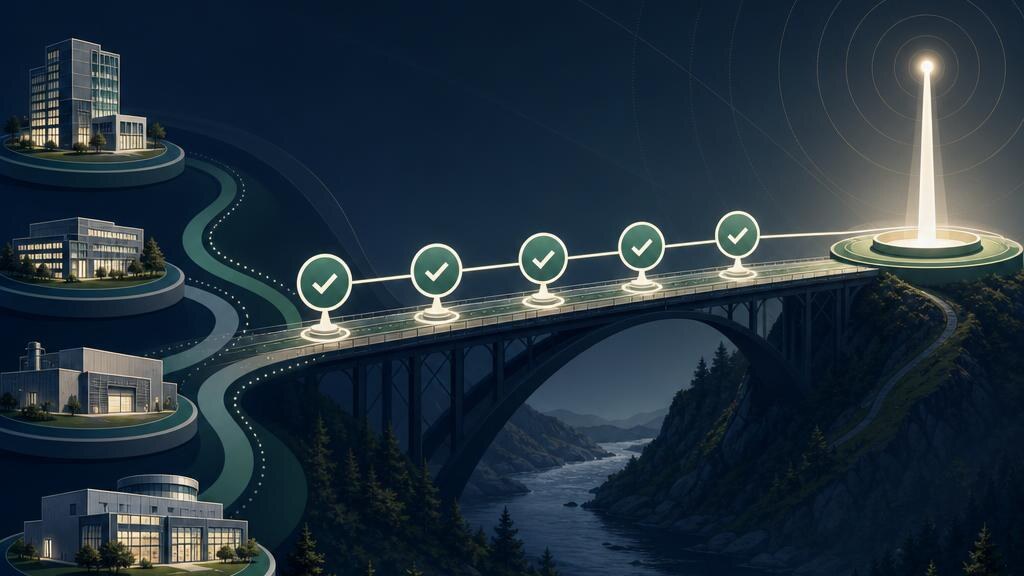
A shortlist becomes a viable Proof of Concept only when the business owner, partner and enabling functions agree what will be tested, why it matters, who decides, and what happens next. Treat the handoff as a decision package, not a calendar invitation. It should make the remaining uncertainties explicit.
What should a shortlist-to-PoC handoff achieve?
The handoff converts a scouting decision into an experiment that a business can responsibly run. It is not a confirmation that the selected company will become a supplier, nor is it a substitute for technical, legal, security, commercial or procurement due diligence.
Four questions are often collapsed into one:
- Feasibility asks whether the proposed approach can work in the defined conditions.
- Technical readiness asks how mature the technology is for those conditions.
- Commercial fit asks whether the offer, economics, operating model and partner relationship make sense for the business.
- Procurement readiness asks whether the organisation can contract, onboard and pay for the work under its policies.
They overlap, but they are distinct. A technology may be feasible in a controlled test and still be too immature to integrate. A mature product may have weak commercial fit. Keeping separate evidence and owners prevents a positive demo being mistaken for a deployment decision.
NASA's Systems Engineering Handbook is useful here as a discipline rather than a template to copy: define needs, measures, interfaces and verification before work starts. Its context is systems engineering, not corporate startup collaboration. Likewise, NASA's Technology Readiness Levels describe technology maturity. They do not assess commercial fit or procurement readiness.
Who needs to agree before the PoC starts?
Name a business sponsor with authority over the problem and a day-to-day owner who can remove operational obstacles. The sponsor makes continuation decisions; the owner coordinates access, users, data and internal contributors.
Bring the partner in early enough to test assumptions, with a clear role, inputs, boundaries and decision route. Involve technical, security, legal, procurement and operational teams when their work can alter scope or timing. No team should discover a material constraint after the partner has been told the PoC is starting.
The logic is consistent with Stefan H. Thomke's Experimentation Matters: experiments need deliberate design and learning, rather than activity for its own sake. The book is about experimentation broadly; it does not provide a corporate procurement process.
What belongs in the handoff package?
Use one shared record a sponsor can read without reconstructing the history from slides, email and meeting notes. Mark each item complete, open, not applicable or blocked, and attach evidence rather than only a status.
| Handoff item | Questions to answer | Accountable owner | Evidence or output |
|---|---|---|---|
| Sponsor | Who owns the business outcome and has authority to continue, stop or redirect the work? | Named business sponsor | Sponsor confirmation and decision rights |
| Problem hypothesis | What problem, user and operating context are being tested? What would the partner's contribution change? | Business owner | One-sentence hypothesis, baseline and assumptions |
| Partner role | Is the company providing technology, implementation, data analysis, integration support, or another defined contribution? | PoC owner and partner lead | Responsibilities, dependencies and named contacts |
| Shortlist rationale | Why was this company selected over alternatives? Which evaluation criteria were decisive and which concerns remain? | Innovation lead | Scoring rationale, dissent and unresolved risks |
| Feasibility evidence | What indicates the approach can work in this use case? What has only been shown elsewhere or in a lab? | Technical lead | Architecture notes, references, test results or demo record |
| Technical readiness | What maturity is needed for the intended environment, interfaces and operating conditions? | Technical lead | Readiness assessment, integration assumptions and test plan |
| Commercial fit | What value, cost drivers, contractual model and internal operating commitment are plausible? | Sponsor or commercial lead | Value case, budget source and commercial assumptions |
| Success measures | What observable result would support the hypothesis? What baseline, threshold and measurement method apply? | Sponsor and measurement owner | Metric definitions, data source and acceptance threshold |
| Scope | What is in and out? Which site, users, data, systems, volume and operating window are included? | PoC owner | Written scope, exclusions and change-control route |
| Timeline | What are the start condition, milestones, review dates and end date? | PoC owner | Milestone plan with dependencies |
| Security and privacy | Will the work use personal, confidential, regulated or production data? Is a security review, data-processing agreement, access review or test environment required? | Security/privacy owner | Triage outcome, required controls and approval path |
| Procurement and legal | Is a supplier record, NDA, contract, insurance, sanctions check, tax form, purchase order or legal review needed? What lead time applies? | Procurement/legal owner | Procurement route, document list and target dates |
| Operating access | Who provides users, facilities, samples, equipment, system access and internal support? | Operational owner | Access plan and confirmed availability |
| Decision gates | What must be true to start, continue, complete, scale, pause or stop? Who decides at each gate? | Sponsor | Gate criteria, decision forum and written authority |
| Knowledge capture | Where will evidence, decisions, change requests, results and lessons be retained? Who writes the close-out? | Innovation lead | Shared repository and close-out template |
Blank cells are open decisions, not consent. A short PoC can still need a longer onboarding lead time.
How should the hypothesis and success measures be written?
Write a hypothesis that can be disproved. A workable form is: If [partner capability] is used by [defined users] in [defined conditions], then [measure] will change from [baseline] to [threshold] within [time], without exceeding [constraint].
For example: “If maintenance planners use the partner's model on the selected asset class for eight weeks, then correctly prioritised inspections will rise to at least 75%, without requiring access to production control systems.” The threshold must reflect the case.
Pair each outcome measure with a guardrail. Identify the measurement owner and source before starting. If the baseline cannot be measured, make establishing it an early deliverable.
The 2024 University of Paderborn and Fraunhofer study comparing corporate venture capital and venture clienting is a useful prompt to keep the use case and adoption conditions central to collaboration with young technology companies. Read it as research on a particular collaboration approach, not as proof that every challenge warrants a venture-client or PoC route.
Which decision gates keep a PoC from drifting?
Use explicit gates. A practical minimum is:
- Start gate: sponsor, hypothesis, scope, budget route, owner and essential prerequisites are confirmed.
- Readiness gate: access, data, environment, responsibilities and measures are ready enough to test.
- Midpoint gate: review evidence and decide whether to continue, adapt, pause or stop.
- Close gate: assess results, costs, risks and limitations against pre-agreed criteria.
- Next-step gate: choose follow-on work, transition to a procurement or implementation process, or close the case.
A close gate should allow a “no” decision. It may establish that the use case is not viable now or that a constraint needs solving first. Record why.
What should security and procurement ask early?
Ask route-setting questions: what data will be used and where processed; whether personal data, connectivity, credentials, production access, site access or subcontractors are involved; and what minimum environment can test safely.
For procurement, establish the contracting entity, NDA and purchase route, required insurance or security evidence, non-negotiable terms and realistic lead time. Procurement readiness is an execution constraint, not a verdict on the technology.
If an essential review cannot finish, change to a safe preparatory scope, delay, or stop.
How should the team preserve what it learns?
At close, capture the hypothesis, baseline, method, evidence, decision, costs, feedback, changes, enabling-function lessons and next-step conditions. Keep rejected alternatives and their reasoning alongside the selected partner.
Distinguish facts from interpretations. “Access approval was incomplete” is a documented fact; “the partner was slow” needs context.
How Coopsaas is relevant
The handoff starts with the quality of the shortlist. Coopsaas can support an AI-assisted scouting workflow, transparent criteria, collaboration and the decision context that accompanies a shortlist into sponsor review. People retain approval authority. See the startup scouting process guide or product page.
It does not manage procurement, replace security, legal, technical or commercial diligence, or guarantee a PoC outcome. Questions about how the product is used can be directed to the FAQ or contact page.
FAQs
Is a shortlist enough to start a Proof of Concept?
No. A PoC also needs a sponsor, hypothesis, scope, measures, owners, prerequisites and gates.
Who should own the PoC?
Assign a day-to-day owner in the business area. The sponsor retains continuation authority.
Does a successful demo prove feasibility?
Not necessarily. A demo may use different data, volume, interfaces or operating conditions.
Are technology readiness and procurement readiness the same thing?
No. Technology readiness concerns maturity for the intended environment. Procurement readiness concerns the organisation's ability to contract and onboard the partner under its policies.
What if security review is not complete?
Do not grant access or process data beyond what policy permits. Consider a lower-risk preparatory scope, delay the start, or stop the work until the required review is complete.
What is a reasonable PoC duration?
Set the shortest period that can generate credible evidence, allowing for data collection, operational cycles and onboarding.
What should happen after an unsuccessful PoC?
Close it with evidence and a decision: changed scope, another partner, later revisit or no further action.
Sources
Accessed 21 February 2025.
- NASA, NASA Systems Engineering Handbook, 2017.
- NASA, Technology Readiness Levels, accessed 2025.
- Stefan H. Thomke, Experimentation Matters, Harvard Business School publisher page, 2003.
- University of Paderborn and Fraunhofer, External Corporate Venturing for Strategic Renewal: A Comparative Study of Corporate Venture Capital and Corporate Venture Clienting, 2024.